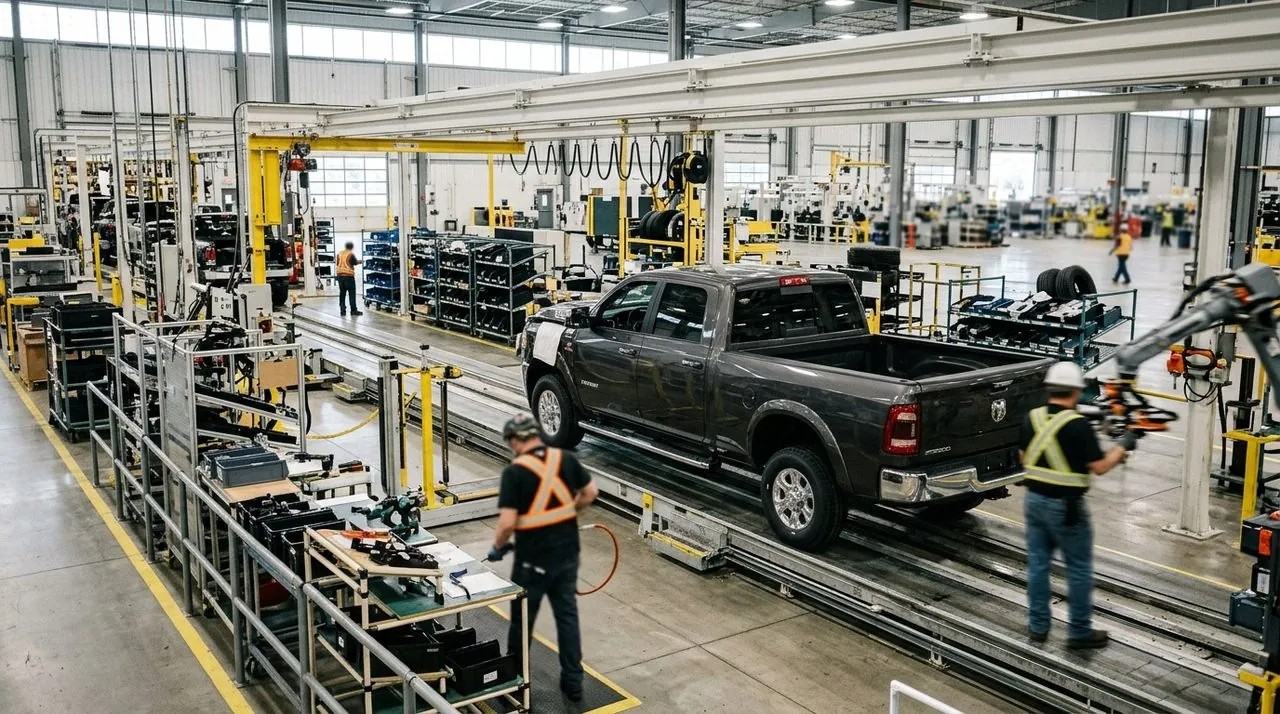
Ford Motor Co. has restarted production at its Oakville, Ont., assembly plant after a closure of more than two years, now focusing on building heavy-duty pickup trucks. More than 2,000 employees have returned to the facility west of Toronto to manufacture Ford's F-Series Super Duty range of large pickups for markets in Canada, the United States and globally. The automaker invested $5 billion to retool the assembly line and construct a new on-site stamping shop for body panels. The federal government provided $464.5 million and Ontario contributed $295 million toward the total project cost. Ford Canada CEO Bev Goodman marked the reopening at a ceremony on Friday, stating, "Today is a big day for Ford and for Canada." The event drew hundreds of auto workers, Ford officials, Premier Doug Ford and Industry Minister Mélanie Joly. Unifor national president Lana Payne, whose union represents about 40,000 Canadian auto workers, described the restart as "nothing short of an industrial rebirth for Canada" and an "act of resistance" during the trade conflict with the U.S.
The retooling proceeded despite the United States expanding its tariffs last year to cover the exact truck models built in Oakville. Goodman said the move reaffirms Ford's 122-year manufacturing commitment in Canada. "This investment in this moment is really about staying true to our commitments," she said. "That's a commitment to manufacturing here in Canada as well as to building new capabilities and supporting jobs here in Canada." The company finalized its plans for Oakville before the U.S. announced tariffs on heavy-duty trucks in October 2025.
Goodman expressed Ford's support for renewing the U.S.-Mexico-Canada Agreement, which previously allowed tariff-free cross-border trade before the Trump administration's measures. "Our investments are long-term," she said. "And they underscore that Canada is very, very important in our global Ford plan, but it's also importantly a reflection of the capability of our team and the demonstration of the quality that they can build here." When questioned about proceeding despite tariffs, Goodman said, "We made a commitment to our employees and made a commitment to our business, and we've retained those commitments, which is important to Ford."
The Oakville facility produced 3,488 trucks in October and has an annual capacity of 100,000 vehicles. Engines for some trucks will come from Ford's Windsor plant, which recently received a US$500 million investment. "So what's really cool here is you're going to have a vehicle built in Oakville with engines from Windsor," said Flavio Volpe of the Automotive Parts Manufacturers' Association. Volpe interpreted the reopening as a bet that Canada and the U.S. will eventually remove tariffs and honour the USMCA, calling it "a very public bet that they think they'll have tariff peace between Canada and the U.S."
Employees returning to work shared their relief. Brad Walker, a 14-year Ford veteran who assembles dashboards, said he was glad to be back and never doubted the plant would reopen given customer demand. Brent Hogenbirk, a 30-year plant veteran who tests finished trucks and returned in May, said of the nearly two-year layoff, "It was hard." The plant's revival occurs amid broader trade tensions, a concern highlighted when a Canadian ambassador warned that U.S. tariffs threaten investment. Ford's move represents a major commitment to Canadian manufacturing despite ongoing uncertainty.